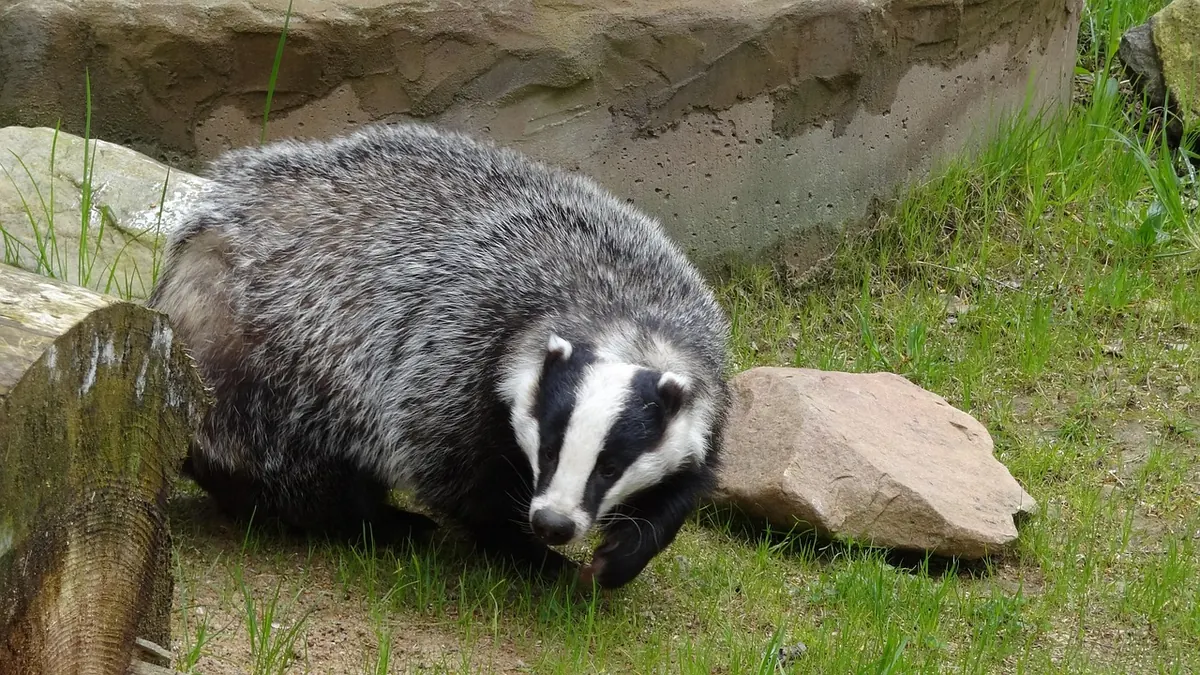
Watch a badger emerge at dusk and the soil usually gives it away. A fresh spill of earth sits outside the sett entrance, pushed out during the night, with a well-worn path leading off into the grass. Digging is not a sideline for badgers. It shapes where they sleep, what they eat, how they raise cubs and how they keep track of the neighbours. Knowing why they dig — and what the different holes mean — turns a puzzling mess in a lawn into something you can actually read. A single badger can shift several wheelbarrows of soil in a night, and a large sett may represent decades of steady excavation.
Badgers have the equipment for heavy excavation. Their front legs sit low on a broad, muscular body, and each foot carries five long, strong claws that stay permanently out rather than retracting like a cat's. That combination gives them real purchase in compacted soil and clay, and a badger can shift an impressive amount of earth in a single night. The claws on the front feet are particularly powerful, acting like a set of chisels, while the hind feet are used to push loosened soil backwards out of the tunnel.
The results last. Unlike a rabbit warren or a fox earth dug for one season, a badger sett is a long-term investment that can be extended, repaired and reused for years, sometimes by successive generations of the same social group. Badgers also maintain their setts constantly — clearing fallen leaves, remodelling chambers, opening new tunnels when old ones become damp or unstable. Some main setts have been in continuous use for centuries, with new tunnels added as old ones collapse.
A sett is a system rather than a single burrow. Tunnels branch and rejoin, connecting sleeping chambers with entrances that are usually wider than they are tall, giving the classic flattened, roughly D-shaped opening. Large main setts can have many entrances, with well-worn paths radiating out, spoil heaps nearby, and smaller annexe or outlier setts scattered across the group's territory. In Britain, some main setts have more than 50 entrances and hundreds of metres of tunnel, though most are much smaller.
Inside, badgers keep things dry and clean. They collect bedding — dry grass, bracken, leaves, moss — and drag it underground, replacing it regularly. Badgers do not hibernate, so even in winter a sett is still in use, and on mild nights there is still work going on below ground. On warm days, they may drag bedding out to air in the sun before taking it back in.
The main sett gets the most attention of all: more digging, more fresh bedding, more maintenance than the smaller setts used for a night's rest. That is where cubs are born and spend their first weeks underground, and it is the part of a badger's world that is most easily harmed by disturbance. Cubs are typically born in February and first emerge above ground in April or May, by which time the adults have prepared a nursery chamber lined with the softest bedding available.
Much of the digging you see in fields, verges and gardens has nothing to do with setts at all. Earthworms are the mainstay of the badger diet, and badgers find them by pushing their snout through the surface soil and rooting them out, leaving small conical holes — often called snuffle holes — scattered across short grass. One night's foraging can leave dozens of them in a single field. A badger may eat several hundred earthworms in a night, and it will return to the same pasture again and again while the soil is moist.
Badgers dig for other food too. They break into bumblebee and wasp nests, prise out beetle larvae and chafer grubs, and dig up bulbs, roots and fallen fruit. After a dry spell, worms retreat deeper and badgers widen their search, which is why damage to lawns and flowerbeds often appears in late summer and then fades once the rain returns. If you find rolled-back turf in a neat patch, it is often a badger after chafer grubs beneath the roots.
Not every scrape is about food or shelter. Badgers dig shallow pits — latrines — and use them as communal toilets, usually along territory boundaries, beside paths and close to sett entrances. The pits are small but deliberate, and they carry scent from glands beneath the tail as well as the droppings themselves. Latrines are often placed on raised ground, such as a molehill or a tussock, to make the scent carry further.
For a nocturnal animal that lives in a group and shares a border with neighbouring groups, scent is the noticeboard. Latrines, scratched posts and marked paths tell a badger who is where without a fight. Digging a pit is a quick job; keeping it in use is part of holding territory. A well-used latrine can contain droppings from several badgers, and its position tells you exactly where one group's territory ends and another begins.
Before deciding that badgers are ruining something, work out which kind of digging you are looking at.
It also helps to compare badger digging with that of other animals. Rabbit holes are round and often have a pile of droppings nearby, while fox earths are usually larger and may have a strong smell. Badger setts are distinguished by their D-shaped entrances, the sheer volume of spoil, and the well-trodden paths connecting them.
A few practical steps keep the relationship manageable.
In the UK, badgers and their setts are protected by law under the Protection of Badgers Act 1992 (and equivalent legislation in Scotland and Northern Ireland). It is an offence to intentionally kill, injure or take a badger, or to interfere with a sett by damaging, destroying or obstructing access to it. This protection applies even if the sett is inactive. Penalties can include unlimited fines and up to six months in prison. If you need to do work near a sett — for example, building an extension or laying a driveway — you may need a licence from the relevant statutory body. Always check before you dig.
Badgers are one of our most iconic nocturnal mammals, and their digging is a sign of a healthy, functioning landscape. With a little understanding, we can share space with them without conflict.
Badger digging activity follows a seasonal rhythm. In spring, adults are busy repairing winter damage to the main sett and preparing for cubs, so you may see fresh spoil heaps and new tunnels. In summer, especially during dry spells, badgers switch to foraging for chafer grubs and other soil invertebrates, leaving larger, more destructive patches in lawns. Autumn is a time of frantic worm-hunting as badgers build up fat reserves for winter, and you may see many snuffle holes in pastures. In winter, digging is less obvious, but setts are still maintained, and on mild nights badgers may still be active.
Badgers are creatures of habit, and they will use the same paths and setts for generations. If you have a sett on your land, the best approach is to leave it undisturbed and enjoy watching the comings and goings from a distance. Keep dogs away from sett entrances, avoid blocking paths, and never pour anything down a hole. If badgers are visiting your garden, consider it a privilege — and a reminder that your soil is full of life.
With a little patience and the right information, you can tell the difference between a badger looking for dinner and a badger building a home. And that makes all the difference when you find a new pile of earth on the lawn.
Photo: Beeki / Pixabay